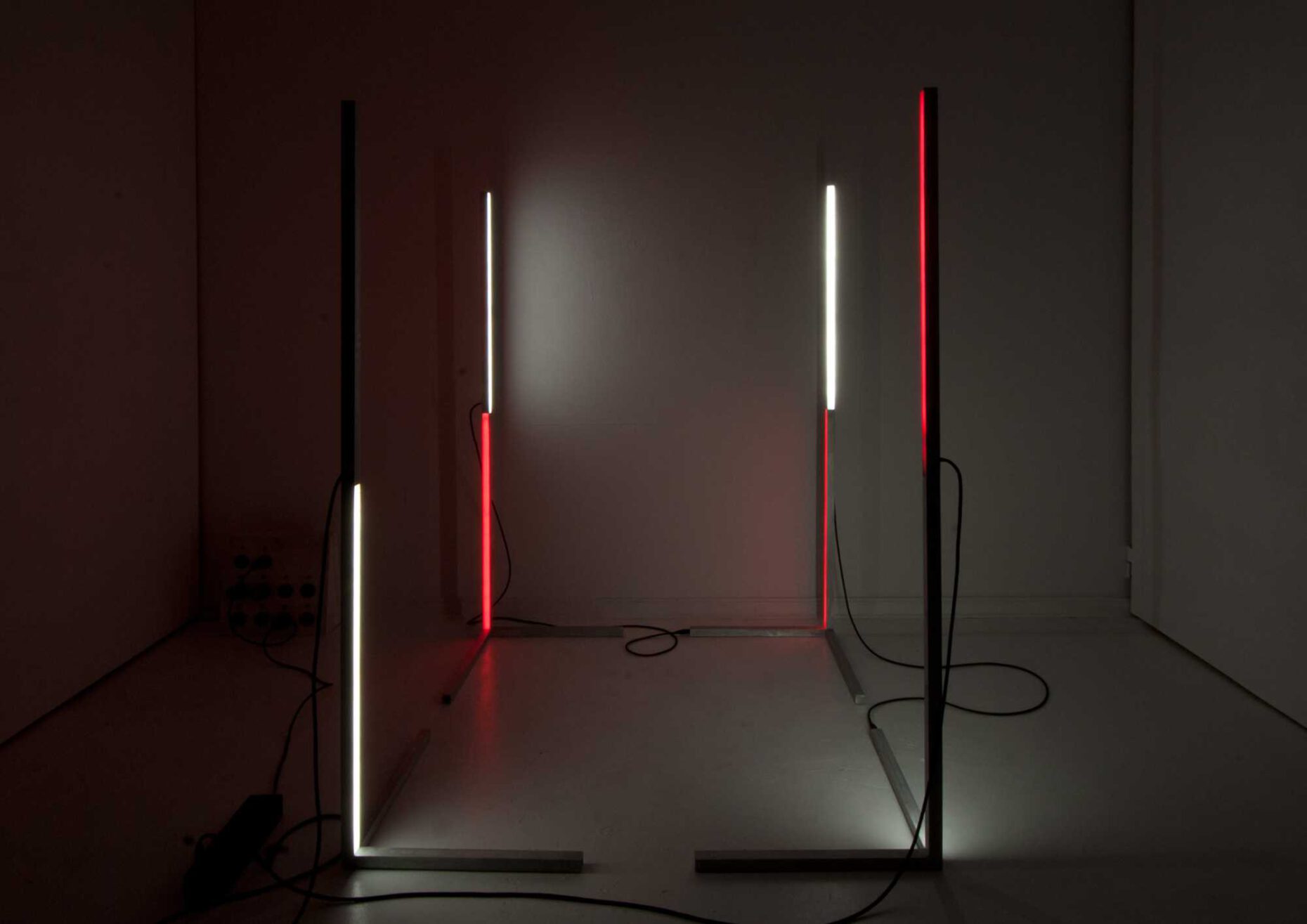
my home is my castle (2019) aluminum, cast acrylic, recycled glass, LED (pp. 54 x 54 x 180cm) – Photo © Joachim Ramin
Light replaces solidity and suggests that space is created less by material than by social, symbolic, and powerful settings. They assert a private space without completely shielding it. This makes the ambivalence of space tangible: it is both a place of retreat and an exposed structure, protection and
assertion, freedom and limitation.
The changeable position wide/narrow reflects and manifests one’s own claim to space, its meaning, and one’s own social location.
Hannah Arendt: The right to privacy is the right not to be seen.
Michel Foucault: Space is fundamental to every form of the exercise of power.
Space is not merely an extension or physical reality, but an existential condition of human existence. As a dwelling and free space, it forms the fundamental prerequisite for humans to be able to locate themselves in the world. In this sense, living means not only occupying a place, but being in the world itself: having a place from which the world can be experienced and in which permanence, protection, and orientation are condensed.
As a private retreat, space opens up the possibility of distancing oneself from the outside world. Only through this distance does freedom become conceivable. Freedom is not merely the absence of coercion, but the ability to escape the grasp of others. One’s own space creates a sphere in which the subject can encounter itself, unobserved, unjudged, and thus autonomous. In a society based on visibility and exchange, private space is the necessary counter-space in which individuality can emerge and exist.
At the same time, space is always a form of positioning. Those who occupy space assert their existence. This assertion is never neutral, but rather an act of declaration: Here I am, here I am staying, from here I speak. Space thus becomes an extension of the self, a spatial manifestation of identity. The way in which space is used, structured, or defended articulates the subject’s relationship to the world.
As property, space takes on an additional symbolic dimension. It becomes a sign of
belonging, power, and social location. Ownership of space means not only disposal, but also visibility in the fabric of other spaces. Self-expression through space is always relational: one’s own space gains meaning in comparison to neighboring, public, or foreign spaces. This makes space a medium of social communication in which values, hierarchies, and lifestyles become legible.
Space thus appears as an ambivalent structure: it enables freedom and limits it at the same time, protects the subject and confronts it with the other. Space is therefore not merely a backdrop for human action, but a constitutive element of human existence.
Website: joachimramin.de/